
Why Python is the Language of AI
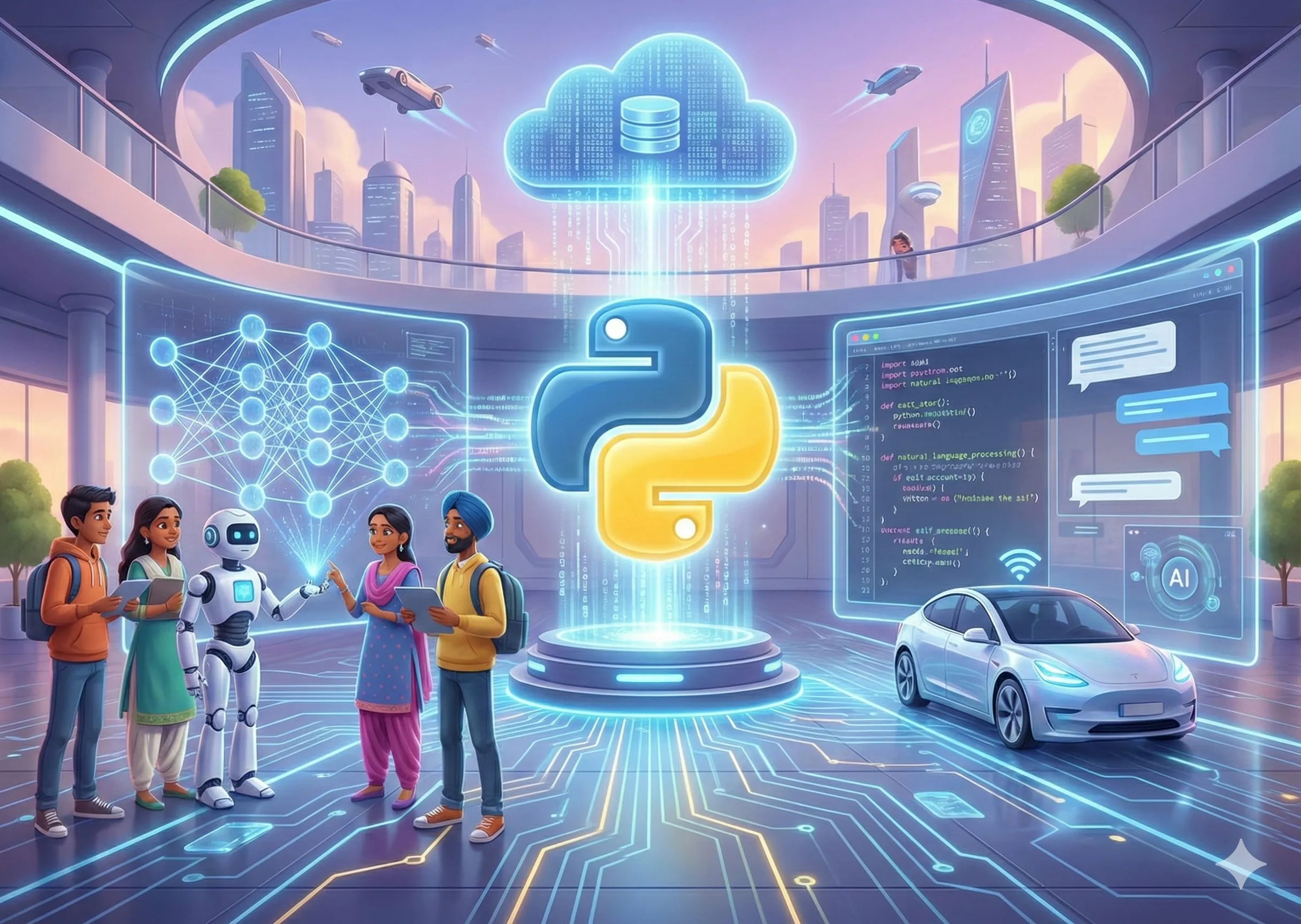
Artificial Intelligence (AI) is no longer just the plot of a sci-fi movie. It’s suggesting the next song on your playlist, it’s helping doctors analyze X-rays, and it’s powering the chatbots you talk to online. AI is rapidly reshaping our world, and at the heart of this revolution is a way for humans to give instructions to machines—programming languages.
As an AI educator at VidyaSopan, I often get asked by parents and bright-eyed students: "If I want to understand AI, where do I start? Which language should I learn?"
My answer is almost always the same: Start with Python.
While there are many powerful programming languages out there, Python has emerged as the undisputed leader in the field of Artificial Intelligence and Data Science. But why? It isn't necessarily the fastest language, nor is it the newest.
In this article, I want to share—from a teacher’s perspective—why Python is the key that unlocks the world of AI for beginners and professionals alike.
What Makes Python Perfect for Beginners
When I introduce programming to middle or high school students for the first time, their biggest fear is that it will look like alien hieroglyphics—complex, confusing, and impossible to read.
This is where Python shines. Python was designed specifically to be readable and straightforward. Its syntax (the rules of how you write the code) looks remarkably close to everyday English.
For example, in many older languages, simply getting the computer to say "Hello World" requires several lines of complex setup code, curly braces, and semicolons. In Python, it’s just one line:
print("Hello World")That’s it.
Because Python gets out of your way, students don't spend hours fighting with confusing syntax errors. Instead, they can focus their energy on the logic, the problem-solving, and the creativity of building something new. This low barrier to entry is crucial for keeping young learners motivated.
Python’s Powerful Ecosystem for AI
While Python is simple on the surface, it has immense depth underneath. Think of Python as a high-quality Swiss Army Knife. On its own, it’s a great tool. But what makes it truly powerful for AI are the specialized "attachments" you can add to it.
In the programming world, we call these attachments "libraries." These are pre-written collections of code that solve specific problems, so you don't have to reinvent the wheel. Python has the best AI libraries in the world.
Here are just a few "superpowers" Python offers:
- NumPy and Pandas: Imagine needing to crunch millions of rows of data in seconds. These libraries handle heavy mathematical calculations and data manipulation with ease, acting like super-charged spreadsheets.
- scikit-learn: This is often the starting point for machine learning. It provides simple, efficient tools for data mining and data analysis, allowing students to build their first predictive models quickly.
- TensorFlow and PyTorch: These are the heavy hitters used for "Deep Learning"—the technology behind things like image recognition and language translation. They allow developers to build complex neural networks (inspired by the human brain).
As an educator, these libraries are invaluable. They handle the complex underlying math, allowing my students to focus on the concepts of AI rather than getting bogged down in calculus.
“Python isn’t just easy — it’s powerful, future-ready, and perfect for young innovators.”
Real-World Use: How Companies Use Python for AI
Sometimes students ask me, "Is Python just for school, or is it used in the real world?"
The answer is that Python literally runs much of the modern internet. It is the language of choice for tech giants and nimble startups alike.
- Google has used Python extensively from its very early days for its search systems and AI initiatives.
- Netflix uses Python to power the machine learning algorithms that recommend what movies you should watch next. * Instagram handles its massive scale of millions of users and photos using a Python framework.
Companies love Python because it allows for rapid "prototyping." They can build an AI idea, test it, break it, and fix it very quickly. In the fast-moving world of tech innovation, speed is everything.
Python for Students: The Perfect First Language
At VidyaSopan, our mission is to make AI education accessible to every child in India. We believe Python is the best vehicle for that mission.
When students learn Python, they aren't just learning a "kiddy" language that they will outgrow. They are learning a professional-grade tool in a user-friendly environment.
- It Builds Confidence: Because students can write code that works almost immediately, they gain confidence quickly. This "quick win" is vital in education.
- Project-Based Learning: Python is incredibly versatile. A student can use it to analyze climate data for a science project one day, and build a simple chatbot or a game the next day.
- Learning Future Job Skills: By learning Python in high school, students are already acquiring one of the most in-demand skills in the global job market.
Python and AI Careers in India
The tech landscape in India is exploding. The government’s push for "Digital India," combined with immense investment from private companies, has created a massive demand for skilled professionals in Data Science, Machine Learning, and Artificial Intelligence.
Whether it’s in Bangalore’s startup hubs, Hyderabad’s tech parks, or emerging tech centers across the country, recruiters are looking for people who understand data and AI.
Careers in these fields—such as Data Scientists, AI Engineers, and Automation Experts—are among the highest-paying and fast-growing roles in the country. Learning Python is the foundational step toward securing these future opportunities.
My Experience Teaching Python
Over my years as an AI educator, I’ve seen incredible transformations. I remember one student in particular who was terrified of math and convinced she couldn't code. We started with Python. Because it read like English, her anxiety lowered.
Within a few weeks, she wasn't just coding; she was using Python’s libraries to analyze a dataset about her favorite sports team to predict future wins. The moment she realized she could use code to answer real-world questions, her perspective shifted entirely.
“The best way to predict the future is to create it.”
– Alan Kay
Python allows students to move quickly from "learning syntax" to "creating projects." That shift from consumer to creator is magical to watch.
Python in VidyaSopan Programs
At VidyaSopan, our 4-weeks Python Basics Program is designed specifically for beginners in middle and high school. We strip away the jargon and focus on practical fundamentals. In our AI workshops, we use Python to let students build things like basic recommendation engines or image classifiers in just a few sessions.
We ensure that whether a student is attending from a private school in a metro or a government school in a rural district, the learning curve feels manageable and exciting.
Conclusion
If you are a student looking to understand the future, or a parent wanting to equip your child with essential 21st-century skills, Python is the place to start. It is the bridge between human creativity and artificial intelligence. It is simple enough to start today, yet powerful enough to build the innovations of tomorrow.
Don't let the buzz around AI intimidate you. The tools to master it are more accessible than ever before.